Customers order however they want
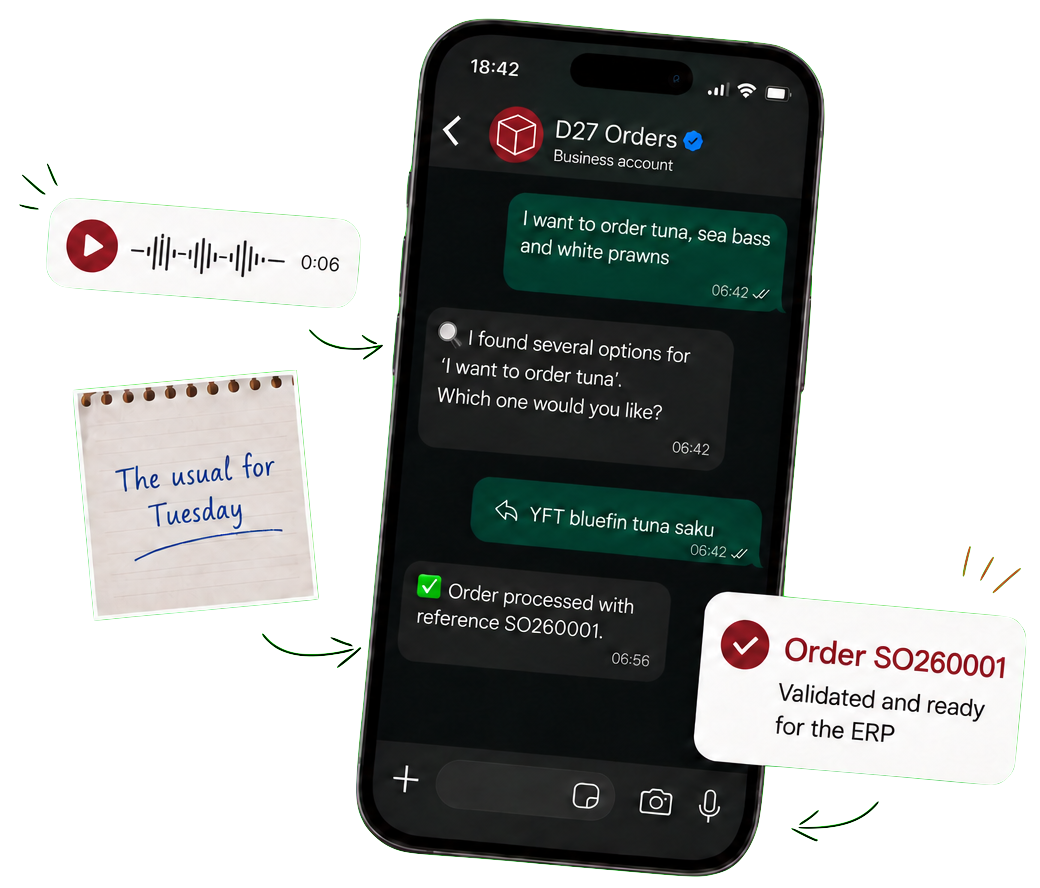
Ambiguous messages: "The same as last week, but without squid". Voice notes from the kitchen with background noise. A photo of a handwritten list. Unstructured emails someone has to decipher.
D27 Orders · Frictionless ordering
Text, audio, photo or “the usual”. D27 Orders interprets each order using your catalogue and customer history.
The channel already works for the customer, but the internal operation still absorbs time, manual judgement and too many repetitive checks.
Ambiguous messages: "The same as last week, but without squid". Voice notes from the kitchen with background noise. A photo of a handwritten list. Unstructured emails someone has to decipher.
Someone on your team has to read, interpret, guess, find references and type the order by hand. Every day, on every order: wasted time, mistakes and delays that affect service.
D27 Orders is the intelligent layer between the customer channel and your ERP. Without replacing your ERP or your team’s judgement. D27 Orders interprets what customers send and turns it into validated, traceable orders that are ready to prepare.
A flow designed to reduce typing, focus human judgement on exceptions and turn the customer channel into a traceable operation.
Text, audio, photo or "the usual". Through WhatsApp or email. No installation, no new portal, no rigid format.
The system detects products, quantities and observations and uses your product catalogue, references and customer order history. It interprets the information and structures it into a valid order for your ERP.
If an exception appears in the order it becomes visible in the system so the team can review it. You move from typing orders manually to simply reviewing them.
More traceability, fewer errors and better visibility of status from the original message to confirmation.
D27 Orders learns from order patterns and suggests commercial opportunities based on similar customer habits.
Order through WhatsApp. No installation, no portals and no passwords.
D27 Orders only proposes products from your ERP, prioritising previous orders.
AI resolves routine work while your team decides on the exceptions.
Upload your catalogue and connect your ERP. The order arrives validated and ready.
From WhatsApp intake to operational integration, D27 Orders covers the full flow with validation, control and traceability.
Receive orders through WhatsApp in text, audio, image or informal list format.
Interpret recurring orders and common expressions such as "the usual" or "same as last week".
Identify products, references, formats, quantities and commercial conditions.
Validate against catalogue, customer history, prices and operating rules.
Detect ambiguities, exceptions and missing information before processing.
Send automatic confirmations and request clarifications when needed.
Operate from a centralised control panel with statuses, traceability and exception management.
Integrate with ERP, CRM, OMS and other internal management tools.
Generate actionable commercial data: buying habits, recurrence and replenishment opportunities.
Teams that already receive orders in informal formats and need to turn them into faster, cleaner and more traceable operations.
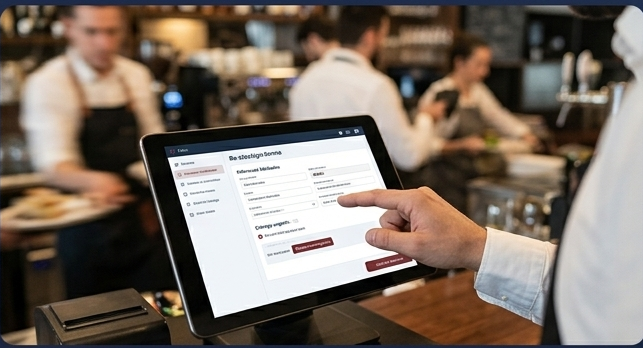
Restaurants, bars, hotels and cafés ordering during service, with recurring references, urgent replenishment and little tolerance for friction.
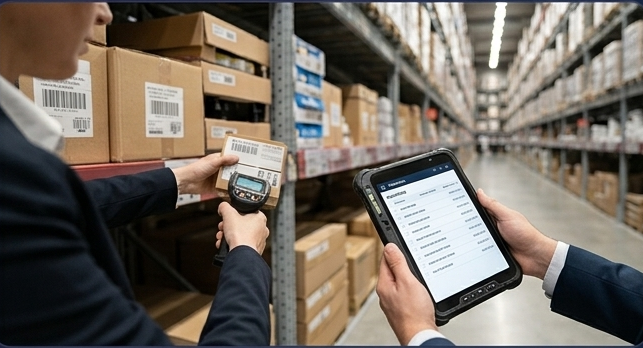
Professional customers with repetitive orders, specific conditions and the need for fast replenishment. Commercial teams that receive orders during visits, calls or WhatsApp conversations and want to cut the administrative work afterwards.

Companies where a significant part of the day is still spent reading messages, listening to audio, copying orders and resolving operational doubts before anything can be processed.

Organisations that manage orders by branch, route, tariff, warehouse or commercial condition and need to centralise the information in a structured way.
Start a pilot
Request a D27 Orders demo and review with your team how order handling changes when intake happens through WhatsApp with automatic interpretation and controlled validation.
Customer channel intact · Exception-based validation · Integration with your operation
Clear answers about how D27 Orders receives, interprets, validates and integrates orders into real operations.
D27 Orders is a Dialog27 solution that automates the intake, interpretation, validation and registration of orders received through conversational channels. It turns messages, audio notes, images and informal lists into structured, confirmed orders ready to be handled by the company’s operating systems.
D27 Orders is used to turn orders that arrive in an unstructured way, for example through WhatsApp messages, voice notes or photographs, into structured operational information. It identifies products and quantities, checks the data, handles ambiguities and prepares the order for processing.
D27 Orders reduces the manual work required to read messages, listen to audio, interpret references, copy quantities, resolve doubts and register orders in internal systems. It also helps avoid errors caused by incomplete, ambiguous or manually transcribed orders.
No. D27 Orders does not replace the ERP or the company’s management systems. It acts as an intelligent layer between the customer channel and the operating systems, delivering cleaner, validated information that is ready to work with.
D27 Orders is designed to receive orders through WhatsApp in different formats such as text messages, audio, images and informal lists. The exact channels are defined during the setup of each project.
No. Customers can place the order through WhatsApp without installing an extra app or learning a new platform. They keep using a familiar channel and a natural way of communicating.
Yes. D27 Orders can process audio orders and interpret the information needed to structure them, such as products, references, formats and requested quantities.
Yes. D27 Orders can receive and interpret images, such as photos of product lists or handwritten orders. The recognised information is converted into structured data and checked against the configured validation rules.
Yes. D27 Orders can use customer history and company configuration to interpret common expressions such as "the usual" or "same as last week". If the request cannot be resolved with enough certainty, the system asks for clarification or routes the case for review.
D27 Orders can identify operational data such as the customer, products, references, formats, quantities and commercial conditions related to the order. The exact scope depends on the catalogue, rules and integrations configured by each company.
D27 Orders can compare the received information with the product catalogue, customer history, applicable prices, commercial conditions and operating rules defined by the organisation.
When information is missing, an unknown reference appears or a possible inconsistency is detected, D27 Orders can request clarification from the customer or mark the order as an exception for the team to review.
Yes. D27 Orders presents a proposed order with the interpreted information so the customer can review and confirm it. Once it is validated and confirmed, the order can continue to the relevant operating system.
Complete and coherent orders can move forward with minimal intervention. Doubtful, incomplete or exceptional cases are separated for review. This means automation focuses on clear orders while the team keeps control over the decisions that need judgement.
No. D27 Orders reduces repetitive work but keeps human intervention in doubtful orders, exceptions and situations that require commercial judgement. The goal is for the team to spend time where it really adds value.
D27 Orders can integrate with the ERP and with other internal tools so that structured orders are delivered ready for management. The feasibility and scope of the integration depend on the system used and the needs of each organisation.
In addition to the ERP, D27 Orders can connect with systems such as CRM, OMS and other internal management tools. The required integrations are defined during solution setup.
Setup may include the product catalogue, commercial conditions, prices, validation rules, criteria for human review, enabled channels and integrations with internal systems.
Yes. D27 Orders centralises process information and makes it possible to know the order status, the information received, the validations performed, the confirmations and any possible exceptions.
After interpretation, validation and confirmation, the order is structured and can be registered in the ERP or made available to the relevant system for preparation and delivery.
D27 Orders is mainly aimed at distributors, wholesalers and commercial networks that receive frequent orders through WhatsApp or other conversational exchanges and need to turn them into structured operational information.
Yes. D27 Orders is suitable for distributors serving restaurants, bars, hotels and cafes, especially when customers place orders during service, use recurring references or need fast replenishment.
Yes. D27 Orders can help commercial, telesales and order administration teams that currently spend time reading conversations, listening to audio, interpreting requests and copying information manually into internal systems.
Yes. D27 Orders can be configured for organisations that need to associate orders with different branches, routes, warehouses, prices or commercial conditions.
Yes. The solution is especially well suited to repetitive or replenishment orders. It can use customer history to interpret common expressions and better contextualise incoming requests.
D27 Orders helps reduce administrative work, transcription errors and processing times. It also centralises information, improves traceability and lets the team focus on exceptions, customer service and commercial attention.
By structuring the orders, D27 Orders can provide information about buying habits, recurrence and potential replenishment needs. The exact availability of those insights depends on the configuration and connected sources.
Not necessarily. Each deployment is adapted to the catalogue, business rules, commercial conditions, internal systems and supervision criteria of the organisation.
D27 Orders can be a good fit if a significant part of your orders arrives through WhatsApp, audio, images or informal messages and your team has to interpret and register them manually. Dialog27 can analyse the current process and assess which parts can be automated.
You can request a trial or demo through Dialog27’s contact form. The team will review the order process, the channels used and the company’s integration needs.